
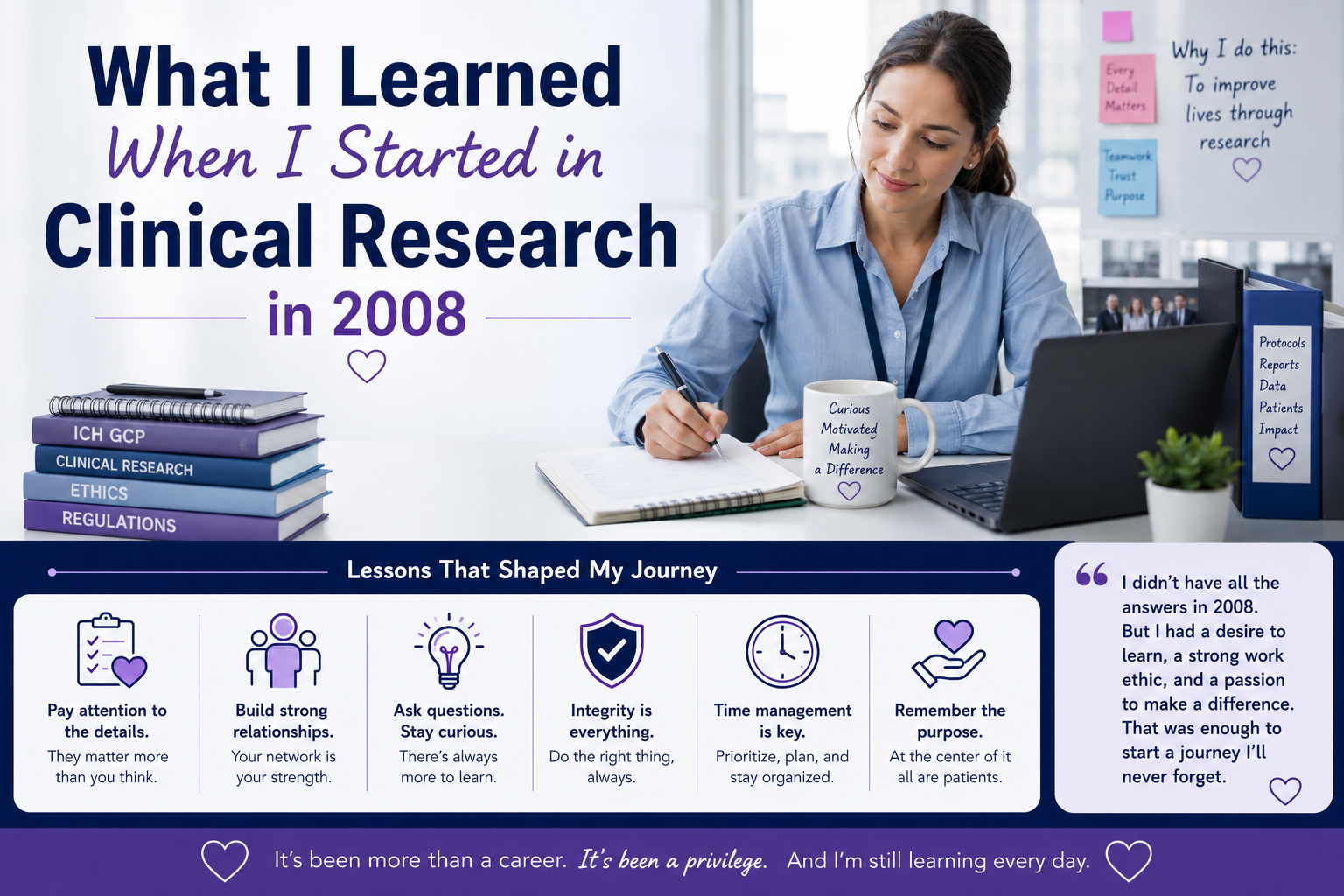
What I Learned When I Started in Clinical Research in 2008
When I started in clinical research in 2008, I thought my healthcare background had prepared me for the job.
I had already worked in several healthcare roles — as a medical assistant, EKG technician, and hospital unit secretary.
What I did not realize was that none of those experiences would fully prepare me for what clinical research actually was.
Because clinical research is not straightforward.
From the outside, I assumed trials followed a simple process — enroll patients, collect data, complete the study.
The reality was very different.
Every Protocol Is Its Own World
One of the biggest adjustments for me was realizing that no two studies operate the same way.
Every study has its own protocol. Every protocol has its own rules. Every sponsor has its own expectations.
Timing Is Not Flexible
In clinical research, timing is not a suggestion.
A lab collected outside the protocol-defined window is not simply an inconvenience.
Documentation Is Everything
Another lesson became foundational to the way I work to this day:
If it is not documented, it did not happen.
Patient safety
Protocol compliance
Data integrity
Site credibility
Study reliability
You Are More Than Your Job Title
I was not simply a coordinator following instructions.
I was educating patients about complex procedures they did not fully understand.
I was helping frightened participants feel safe enough to continue in a study.
What Clinical Research Gives Back
Clinical research will challenge you in ways no training manual fully prepares you for.
But it also gives you something that very few careers can offer:
The knowledge that your work directly contributes to something larger than yourself.
And for many of us, that responsibility is what keeps us committed to this industry year after year.
Asma Siddiqui, CCRA
Founder of Syncreon Research Lounge