
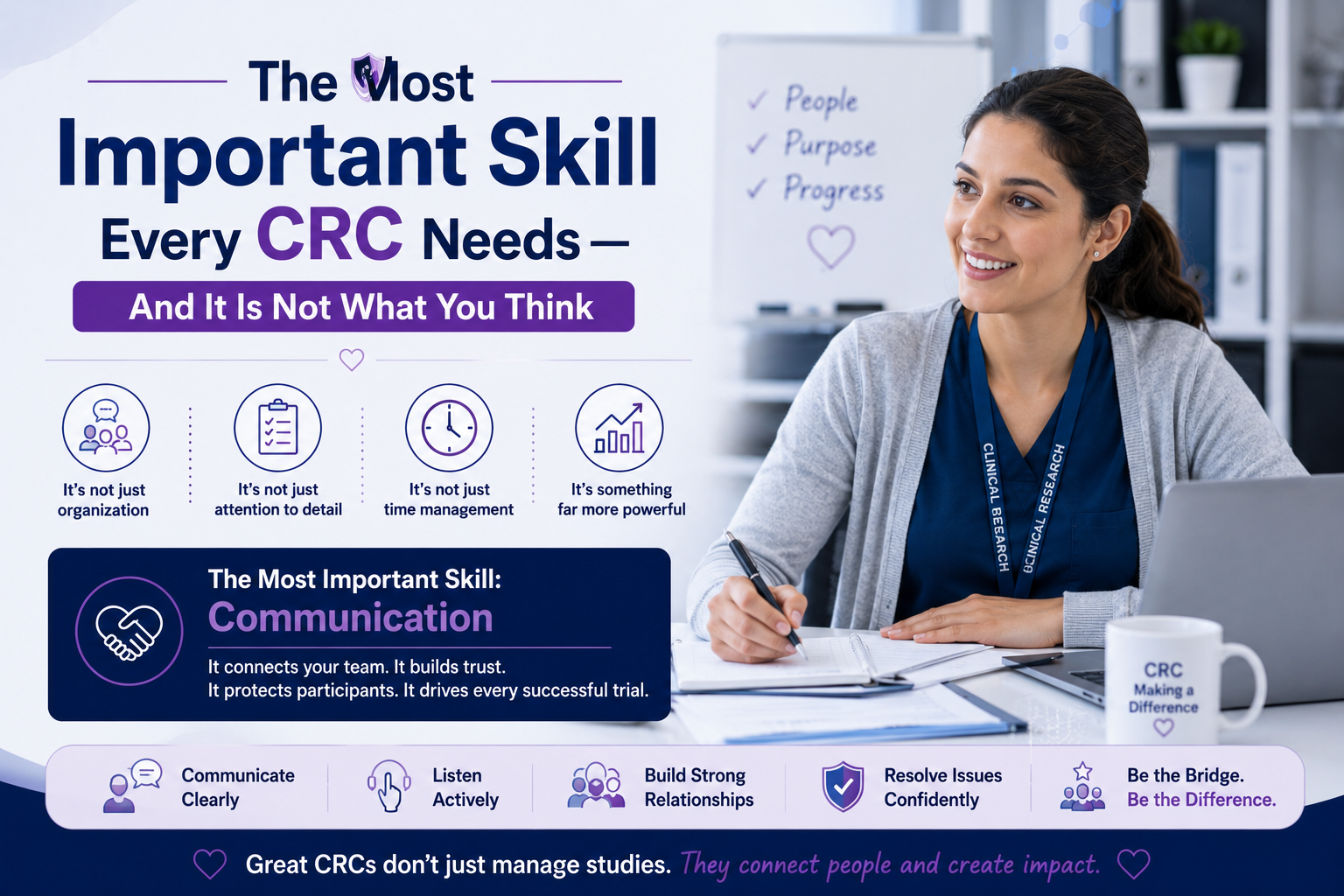
The Most Important Skill Every CRC Needs — And It Is Not What You Think
When I first became a Clinical Research Coordinator, I thought the job was mostly about procedures.
Take the vital signs.
Perform the ECG.
Draw the blood.
Complete the visit correctly.
I focused heavily on accuracy, protocol compliance, and making sure every required task was completed exactly as instructed.
What I did not fully understand yet was that the most important part of the job had very little to do with procedures themselves.
It was communication.
Because as a CRC, communication shapes nearly every part of the patient experience.
It ultimately influences retention, compliance, trust, and study success more than many people realize.
What CRC Communication Actually Looks Like
As a CRC, you become the face of the trial for every participant who walks through the door.
You are often the first person they see at a visit.
You are the person explaining procedures and expectations.
You are the person answering difficult questions.
You are the person helping them navigate uncertainty, fear, or confusion.
You are the last person they speak to before they leave.
Everything about a participant’s experience with the trial flows through your communication.
And that communication directly affects whether patients remain engaged in the study.
Patient retention remains one of the biggest operational challenges in clinical research.
Sometimes patients leave because they did not feel understood, informed, or supported throughout the process.
What Exceptional CRC Communication Looks Like
The best CRCs I have worked alongside all shared one important quality:
They made patients feel respected.
Not by making unrealistic promises.
Not by spending endless amounts of extra time they did not have.
But by communicating with patience, clarity, professionalism, and genuine attention.
They listened fully before responding.
They explained procedures in language patients could actually understand.
They recognized fear or hesitation before immediately shifting into protocol terminology and visit requirements.
They understood that informed consent is not just a signed document.
It is an ongoing process of communication and trust.
And patients notice the difference.
A participant who feels comfortable asking questions is more likely to remain engaged in the study.
A participant who trusts the study team is more likely to stay compliant with visits, procedures, and follow-up requirements.
Strong retention ultimately protects data integrity, study continuity, endpoint reliability, and overall trial success.
Communication Beyond The Patient
CRC communication extends far beyond patient interactions.
Every day, coordinators communicate with Principal Investigators, sub-investigators, sponsors, CRAs, regulatory teams, laboratories, vendors, and internal site staff.
Each relationship requires a different communication approach.
With a PI, communication must often be concise, organized, and respectful of limited clinical time.
With a CRA, communication must remain transparent and proactive — especially when issues arise.
With sponsors, communication reflects the professionalism, responsiveness, and operational quality of the site itself.
Strong communication builds trust.
Poor communication creates operational friction that eventually affects the entire study team.
One Lesson I Learned Early
One lesson stayed with me very early in my CRC career:
When a patient asks a question, stop and answer it completely.
Even when the clinic is busy.
Even when the schedule is behind.
Even when the question seems simple.
Because that participant trusted the study team with something significant.
Their time.
Their health.
Their personal information.
And often their hope that the trial may help them or future patients.
That trust deserves your full attention every single time.
The Question I Ask After Every Patient Visit
After patient visits, I often ask myself one question:
Did this patient leave feeling more informed and supported than when they arrived?
If the answer is yes, that is meaningful coordination.
If the answer is no, that becomes the lesson for the next visit.
Because exceptional coordination is not only about completing procedures correctly.
It is about guiding patients through a process that can often feel overwhelming, unfamiliar, and emotionally difficult while still maintaining protocol compliance, documentation accuracy, and operational consistency.
That balance is what makes great CRCs exceptional.
Communication Is Not A Soft Skill
In clinical research, communication is not separate from the work.
It is part of the work.
For CRCs, communication influences patient retention, visit compliance, informed consent quality, participant trust, site reputation, team coordination, and overall trial success.
The longer I have worked in this industry, the more convinced I become that some of the strongest coordinators are not simply the most technically skilled.
They are the ones who know how to combine operational precision with human connection.
That combination is what patients remember long after the visit is over.
Asma Siddiqui, CCRA
Founder of Syncreon Research Lounge